
National 3D Hydrogeological Framework: Open-Source Infrastructure for Sustainable Groundwater Futures
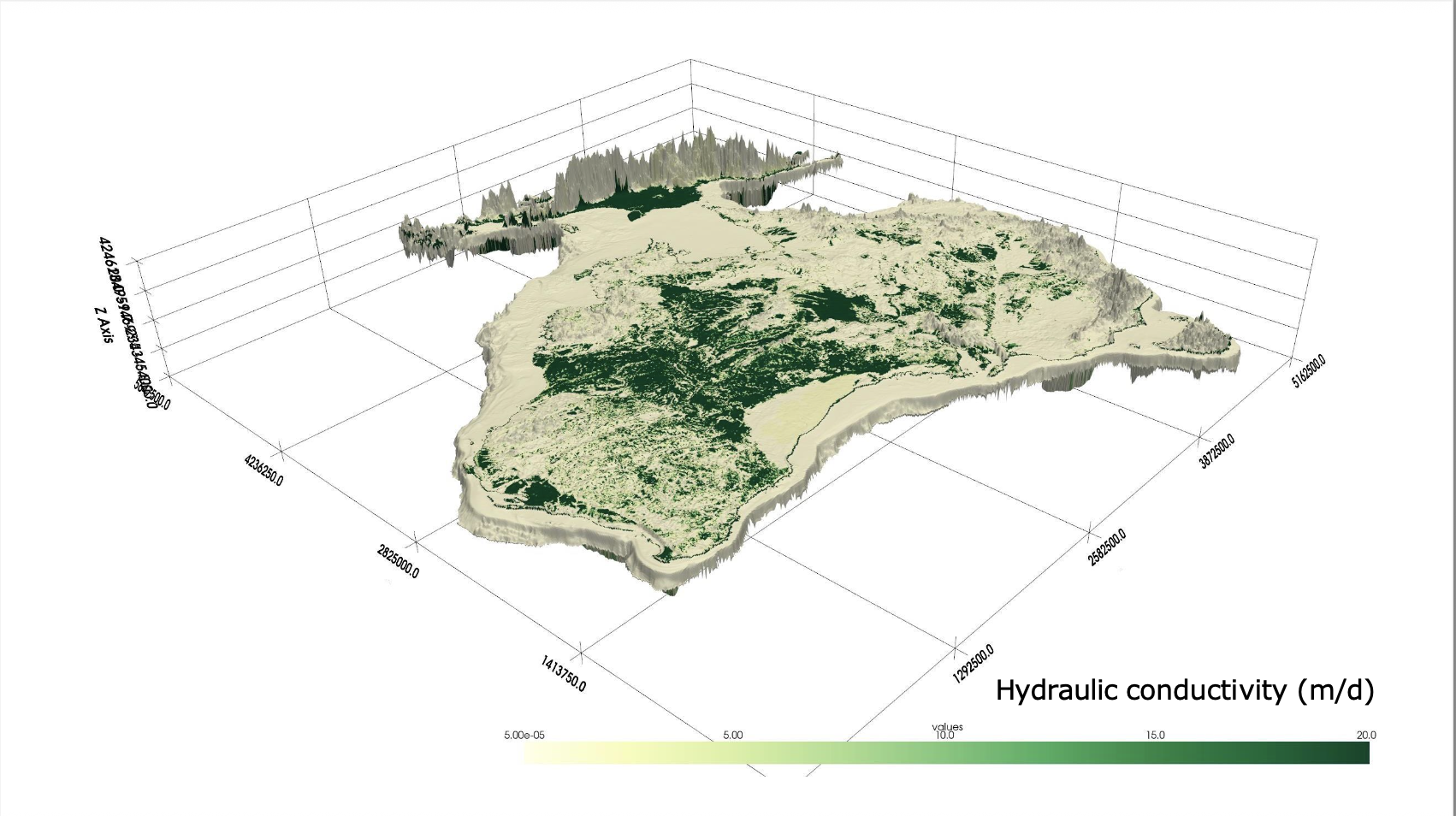
Image: Daniel Zamrsky
The National 3D Hydrogeological Framework will deliver Australia’s first open‑access, continent‑scale 3D numerical model of groundwater systems, enabling informed decision-making across sustainable water use, agriculture, critical minerals, and environmental management.
Overview
Led by Dr Sara Polanco at the University of Newcastle, this project transforms an existing research‑grade 3D groundwater numerical model into a national digital infrastructure asset. Built using advanced modelling tools and datasets, the framework helps researchers, governments, and industry better understand groundwater dynamics.
The team will integrate the model with the National Computational Infrastructure (NCI), refine and validate it through regional case studies in the Murray–Darling Basin, and develop tools for regional subsetting, AI‑driven data mining, and model refinement. Comprehensive documentation, training materials, and governance frameworks will ensure long‑term usability and national uptake.
The Challenge
Groundwater is one of Australia’s most important natural resources — essential for drinking water, agriculture, ecosystems, and the processing of critical minerals. But it’s difficult to understand what’s happening underground because monitoring wells are sparse and Australia’s geology is incredibly complex. Existing models are either too small to inform national policy or too coarse to support local decision‑making. This project fills that gap by creating a single, open, high‑resolution 3D model of the entire continent’s groundwater systems — a tool that can evolve with new data, support climate adaptation, and guide sustainable water management into the future.
Expected Outcomes
A fully open, scalable continental 3D hydrogeological model deployed on NCI’s Gadi supercomputer.
Clipping tools that allow users to extract regional domains for local groundwater studies.
AI‑driven and geostatistical tools for data mining, interpolation, and model refinement.
Comprehensive documentation, workflows, and training materials to support adoption across research, government, and industry.
Regional case studies in the Murray–Darling Basin demonstrating real‑world application and refinement.
"Groundwater does not stop at state borders. This project provides the national-scale framework needed to understand, manage, and protect Australia's vital groundwater resources."
– Sara Polanco, University of Newcastle
What are the benefits?
Improved national water security, with a unified model that supports planning for climate change, drought, and extreme climate events.
Better decision‑making for agriculture, critical minerals, and environmental management.
A future‑ready digital infrastructure, enabling AI‑assisted analysis, regional adaptation, and integration with Earth system models and national policy frameworks.
Who will benefit
Several communities will benefit from this project, including:
Researchers in hydrology, geoscience, climate science, and environmental modelling.
Government agencies and water planners responsible for groundwater allocation, climate adaptation, and environmental protection (i.e. Climate Change Authority).
Industry stakeholders, including agriculture, mining, and critical minerals processing.
Consultants, educators, and students who need accessible, high‑quality groundwater data and modelling tools.
National research initiatives from TERN, NCI, and ACCESS‑NRI will gain better modelling tools to improve data quality and research capabilities.
Access
All model components — code, workflows, metadata, and parameter sets — will be openly available on GitHub in accordance with FAIR principles.
The national model will be deployed on NCI’s Gadi supercomputer, with versioned releases and DOIs minted through the NCI–AuScope partnership.
Users will be able to run regional analyses using clipping tools, reproducible pipelines, and AI‑ready workflows.
Interoperability with AuScope’s M@TE platform ensures long‑term accessibility, transparency, and integration with other geoscience models.
Project Name
National 3D Hydrogeological Framework
Project Lead

Timeframe
Jul 2026 to Jun 2028
Status
Active
Funding
Pilot 5
Host
The University of Newcastle
NCRIS Collaborators
National Computational Infrastructure (NCI)
Other Collaborators
National Centre for Groundwater Research and Training (NCGRT)
IHE Delft Institute for Water Education
University of New South Wales (UNSW)
AuScope Programs
Acknowledging AuScope
This project was made possible by support from the National Collaborative Research Infrastructure Strategy (NCRIS) through AuScope. Acknowledging AuScope and NCRIS helps us demonstrate the value of shared research infrastructure, ensuring continued support and resources for the research community.
If you helped deliver this project or have benefited from its outputs, please credit AuScope so we can include your work in our impact reporting. For examples of acknowledgment, please visit our ‘Acknowledge AuScope’ page.
We’d love to see your work—please tag us on social media using:
@auscope | #AuScopeImpact | #NCRISimpact