
FieldScope Australia
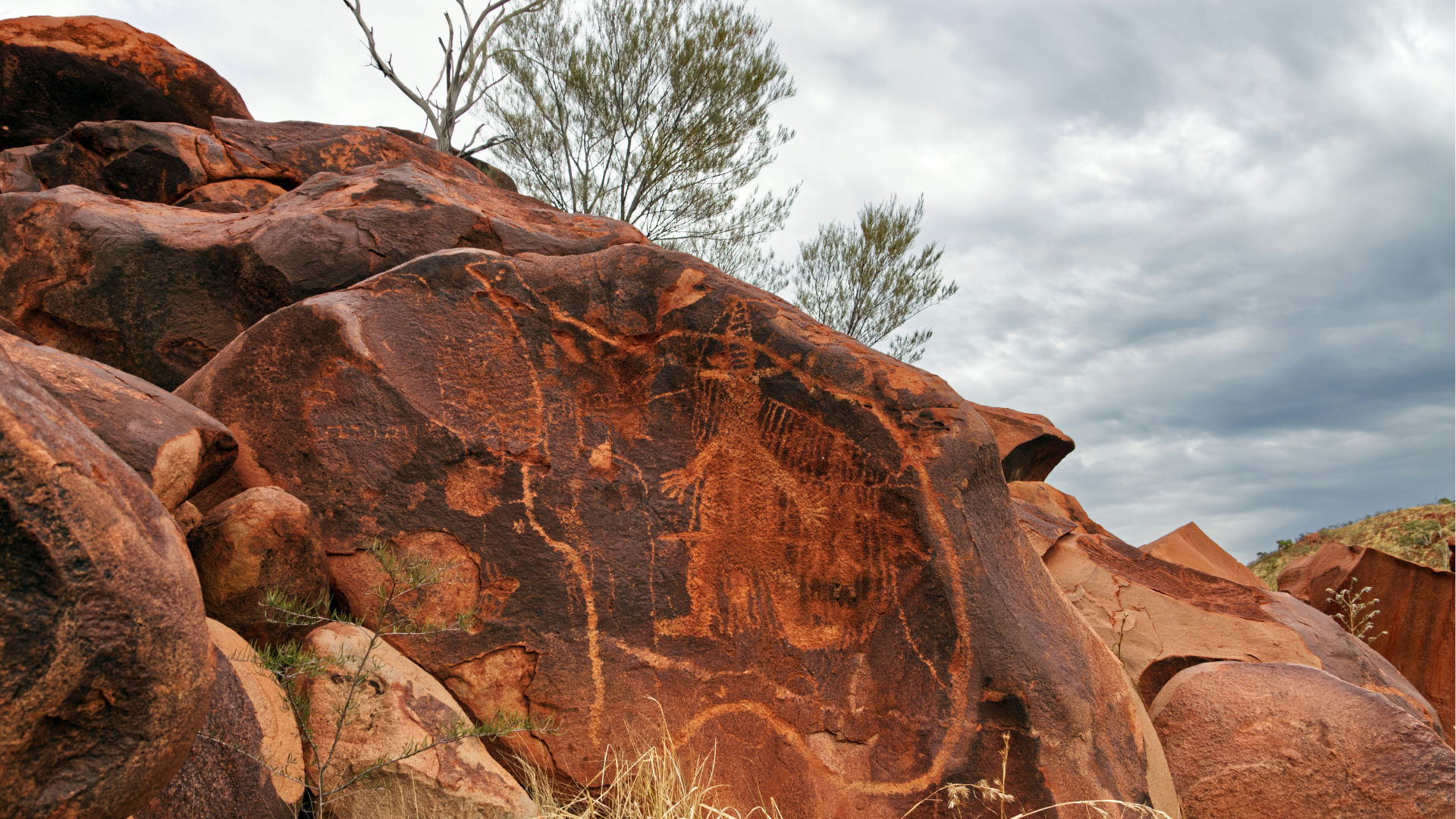
Indigenous Art in the Australian Outback. Image: René Riegal
Leveraging AuScope's "Downward Looking Telescope" framework, this project aims to create accessible field guides for capital and regional locations, covering deep-time geology, contemporary climate issues, and connections to First Nations Country.
Overview
Led by Associate Professor Kelsie Dadd from the University of Sydney, this project aims to develop open-source field-teaching materials that leverage AuScope's "Downward Looking Telescope" framework.
Working with a national network of educators from a range of organisations, including the Australian Institute of Geoscientists (AIG) and the Teacher Earth Science Education Programme (TESEP), Kelsie’s team aims to create accessible field guides for capital and regional locations that cover deep-time geology, contemporary climate issues, and connections to First Nations Country. These materials will incorporate AuScope data and models, ensuring accessibility while demonstrating Earth Science's relevance to Australia's future.
The Challenge
Earth Sciences fundamentally underpin both the economic and social well-being of Australian society. As highlighted by numerous reports, including the Australian Academy of Sciences response paper, 'Alarming decline in funding of tertiary geoscience departments across Australia’, all highlight reduced tertiary funding and Australian students' perceptions of Earth Science severely impair Australia’s sovereign capabilities and its potential role in addressing 21st-century challenges.
This project focuses on practical, field-based infrastructure, recognising that Earth Science teachers are time-poor, often lack Earth Science training, and need accessible, engaging field experiences for their students. By building an open-source school-focused learning infrastructure, this project aims to address those concerns and help upskill Australia’s future earth scientists
Expected Outcomes
Develop a complete suite of open‑source, curriculum‑aligned field teaching resources for every Australian state and territory, including guides, activities, digital tools, and logistical notes.
Strengthen the connection between existing AuScope infrastructure (DLT, seismometers in schools, GPlates) and secondary education.
Increase Earth Science visibility, relevance and engagement to address declining student enrolments and awareness.
Embed First Nations perspectives and connection to country in field-learning exercises.
Use this pilot as a springboard to expand learning materials nationally through an open-source GitHub repository.
What are the benefits?
Empower Teachers and Students: Ready-to-use, high-quality Earth Science education resources will help teachers confidently prepare a relevant curriculum. This will also improve student engagement by linking Earth Sciences to climate change, natural hazards, and wider socio-environmental issues.
Strengthen Australia’s Future Workforce: By embedding an engaging curriculum in schools, this project aims to improve sovereign capabilities by increasing tertiary enrolments in Earth Sciences. This includes creating a scalable model that can be adopted nationally and internationally (i.e. UNESCO Networks or GeoSciEdX Communities).
Improve Cultural and Outreach: by embedding First Nations perspectives and connection to country, the material aims to equip both educators and students with an understanding of First Nations knowledge systems, improving cultural understanding and social equity.
Who will benefit
Several communities will benefit from this project, including:
Secondary students across Australia, especially those with limited exposure to Earth Science-related curriculum or fieldwork
Secondary educators will gain practical, curriculum-aligned, low-barrier resources for delivering field-based learning.
AuScope and related Earth Science partners (GSA, AIG, TESEP) will benefit from increased awareness of their research and societal relevance at a secondary level.
First Nations communities will gain respectful representation through curriculum and strengthen cultural literacy amongst educators and students alike.
Access
More information to be provided by the project team.
Project Name
FieldScope Australia
Project Lead
Kelsie Dadd
Timeframe
Jan 2026 to Jun 2027
Status
Active
Funding
Pilot 5
Host
The University of Sydney (USyd)
Other Collaborators
Australia Institute of Geoscientists (AIG)
Australasian Universities Geoscience Educators Network (AUGEN)
Geological Society of Australia (GSA)
Teacher Earth Science Education Programme (TESEP)
AuScope Programs
Outreach & Engagement
Acknowledging AuScope
This project was made possible by support from the National Collaborative Research Infrastructure Strategy (NCRIS) through AuScope. Acknowledging AuScope and NCRIS helps us demonstrate the value of shared research infrastructure, ensuring continued support and resources for the research community.
If you helped deliver this project or have benefited from its outputs, please credit AuScope so we can include your work in our impact reporting. For examples of acknowledgment, please visit our ‘Acknowledge AuScope’ page.
We’d love to see your work—please tag us on social media using:
@auscope | #AuScopeImpact | #NCRISimpact