
Welcoming Professor Caroline Tiddy to the AuScope Board

Holding a 3D printed model of MinEx CRC’s RoXplorer® Coiled Tubing (CT) drill rig. Image: Caroline Tiddy.
We’re thrilled to welcome Professor Caroline Tiddy to the AuScope Board. Caroline is widely recognised for her work at the intersection of geoscience research, industry partnerships, and technological innovation. With a career built on collaboration and translating science into real-world impact, she brings a valuable perspective to AuScope’s strategic direction.
Welcome, Caroline! What sparked your interest in joining the AuScope Board, and what aspects of the role resonate most strongly with you?
AuScope is an organisation I have followed for many years through newsletters, social media, and collaborations with CRCs. I have long admired its commitment to equity, particularly through leadership in FAIR data practices, its visiting schools programs, and initiatives that make geoscience accessible and fun. When the opportunity to join the AuScope Board arose, it was AuScope’s collaborative, strategic and impact-driven ethos that resonated most strongly with me, making it an easy decision to accept the invitation.
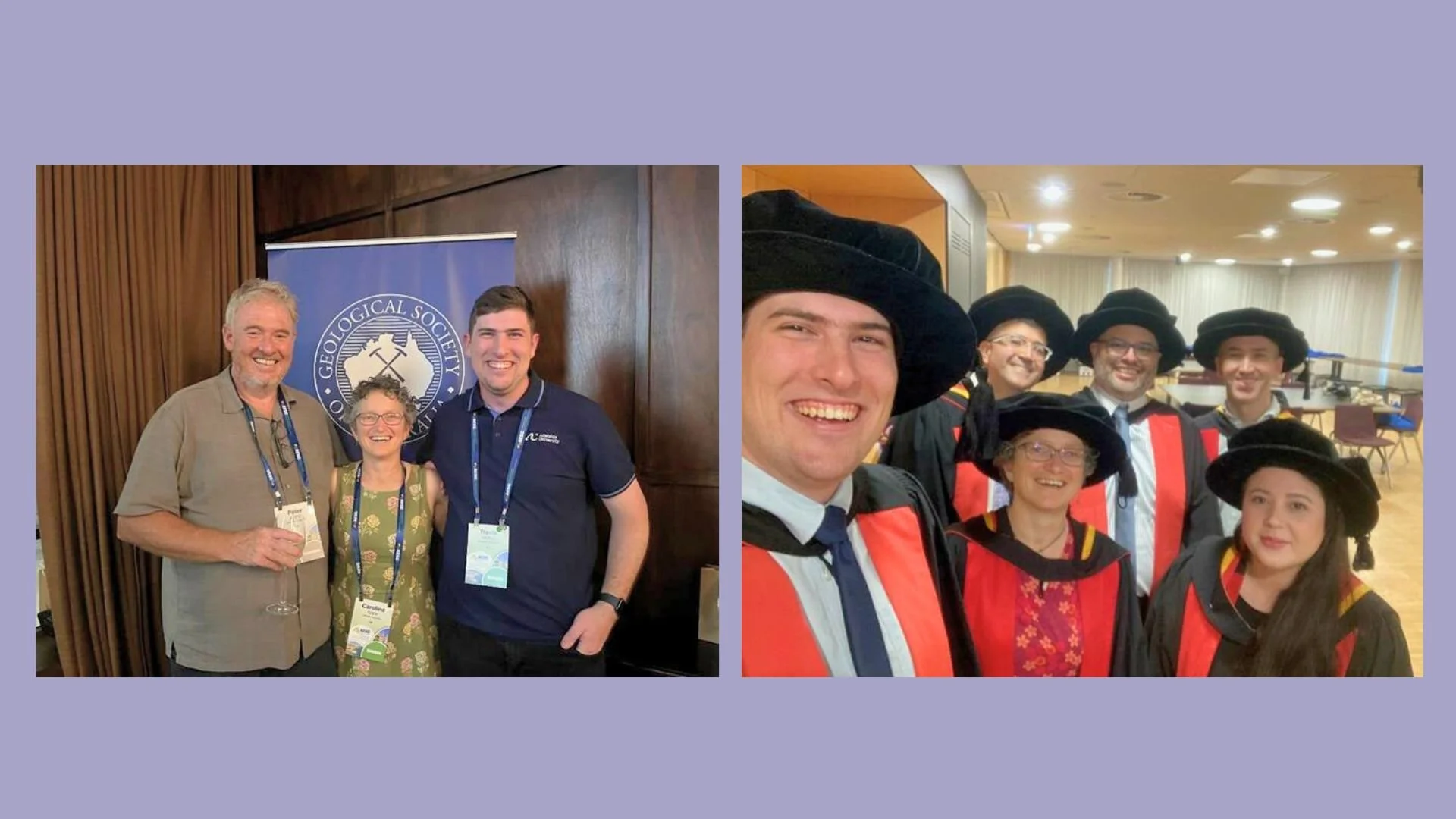
Left: Capturing the ‘academic family tree’. L-R: Pete Betts, me, Travis Batch. Image: Caroline Tiddy. Left: Celebrating the graduation of three of our MinEx CRC students. Back: Mosayeb Khademi Zahedi, Ivan Gutirrez Agramont, Ben van der Hoek; Front: Travis Batch, me, Adrienne Brotodewo. Image: Travis Batch
Your career has spanned research, teaching, and industry engagement. Which experiences have most shaped the way you lead, collaborate, and think about geoscience innovation?
My approach to leadership and innovation has been shaped primarily through roles in Cooperative Research Centres (CRCs) and universities. CRCs are uniquely positioned to enhance competitiveness, productivity and sustainability of Australian industries through industry-led, outcome-focused collaborative research. My roles across multiple CRCs as a PhD student, researcher, Education & Training Coordinator and currently Chief Scientific Officer have seen me engage with industry and the research community at progressively more strategic levels.
In the university context, I have worked in a highly applied research environment within the Future Industries Institute (FII) (now at Adelaide University) for almost a decade. FII undertakes applied research that responds to the needs of industry and the community, with projects spanning the minerals value chain, environmental science, advanced manufacturing, energy, and nanomedicine. Collectively, these experiences have progressively shifted my perspective beyond individual geoscience research projects to the broader question of how collaborative, multi-disciplinary research efforts can transform industry practices whilst aligning with state and national strategic priorities.
Many may not realise what goes into governance for a national research infrastructure organisation. What might surprise people about this kind of work?
What may surprise people (including me) is the sheer breadth and complexity of infrastructure required to genuinely support Australia’s geoscience community. Effective governance depends on a clear, well-communicated strategy that brings coherence to that complexity. Over nearly two decades, AuScope has delivered impact through initiatives including supporting laboratories; field equipment procurement, deployment and maintenance; establishing data platforms; delivering training and developing collaborative networks that collectively strengthen our understanding of Earth processes, resources, geohazards and the environment. The concept of a ‘downward-looking telescope’ and a digital twin of the Earth provides an elegant framework to articulate this vision. Simple, compelling concepts are often the most powerful tools for governing complex systems.
What part of AuScope’s work resonates most strongly with you?
Six months ago, I would have said EarthBank was my ‘favourite’ – development of a one-stop-shop repository for nation-wide geochemical and isotopic data delivered using FAIR data principles. However, that is a very narrow perspective of a geochemist. With my now increased awareness of the true breadth of AuScope’s activities, what now resonates most strongly with me is the concept of the ‘downward looking telescope’ that will see collection, storage and interpretation of a diversity of geoscientific data. It captures the transdisciplinary nature of modern geoscience and recognises that solving today’s major scientific and societal challenges requires integrated infrastructure across diverse data types and research domains.
Discover AuScope’s Downward Looking Telescope.
What do you see as the biggest opportunity for Australian geoscience in the next decade?
That can be a tough question as the landscape of geosciences is changing so quickly. I think a lot of that has to do with AI, which is the most disruptive technology the world has experienced… and is rapidly evolving… and we are not keeping up. AI presents extraordinary opportunities to collect, manage and interpret geoscience data at unprecedented scale and complexity; however, it comes with significant challenges of data quality, ethics, accountability and interoperability for integration of new and legacy datasets into AI workflows. Furthermore, AI-driven geoscience demands infrastructure such as data centres, computer hardware and software and secure networking systems. With careful and strategic implementation, AI presents opportunities for growth and development within all aspects of geosciences, from fundamental understanding of Earth systems and processes through to education and the composition of the future geoscience workforce.
And beyond geoscience — what brings you joy? Any interests, routines, or creative outlets that help you recharge?
My family is my #1! I have an amazing husband who has supported me to be who and where I am today - although I’m continually jealous of him being the ‘fun parent’. We have two kids, a 12 y.o. daughter and 10 y.o. son, who are growing into lovely individuals and who teach me something every day – be it a fun fact, a random joke (Q. What do you call a burnt down Woolworths? A. Coles), a new dance move, patience or tolerance. My recharge is getting outside and into nature by ‘running’ on a regular basis or refocusing the brain by tackling sudoku puzzles. I regularly volunteer for my local Parkrun and find that very rewarding to give back to and meet more of my local community.
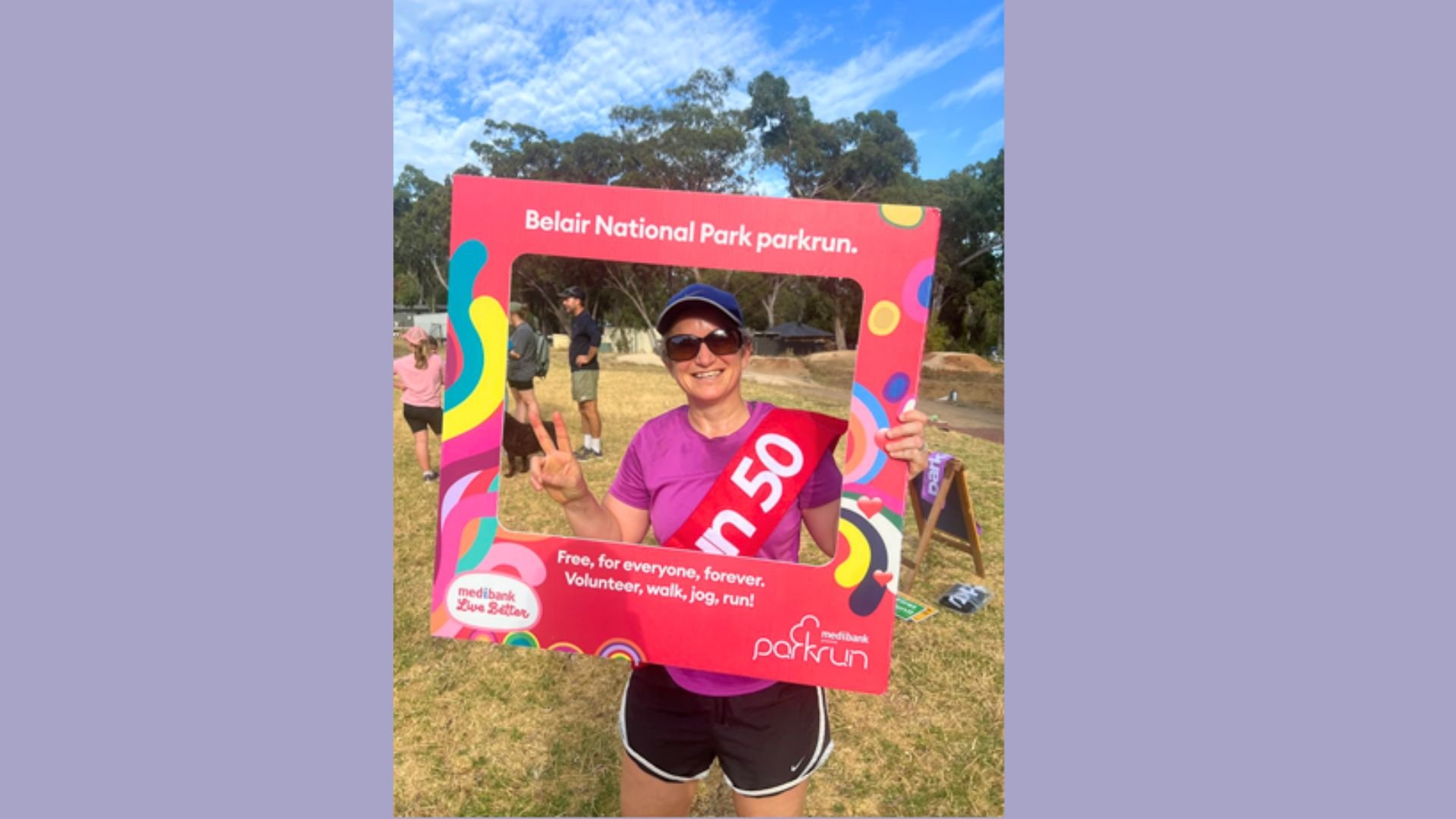
Celebrating my 50th time volunteering at my local Parkrun in January this year. Image: Caroline Tiddy.
AUTHORS
A conversation between Philomena Manifold and Professor Caroline Tiddy from AuScope.