Advancing Subsurface Monitoring Through AuScope and CO2CRC

Aerial shot of the Great Ocean Road in Otways National Park. Image: Unsplash
A collaboration between AuScope and CO2CRC is strengthening Australia’s capability to observe and interpret subtle subsurface processes associated with CO2 injection and storage, while also delivering insights relevant to a wide range of subsurface applications.
Overview
Recent equipment provided by AuScope, including tiltmeters, seismometers and a gravimeter, has been integrated with CO2CRC’s deep downhole fibre-optic sensing systems at the Otway International Test Centre (OITC). Together, these technologies provide exceptional spatial and temporal resolution and position the OITC at the forefront of field-based subsurface monitoring and analysis.
“This collaboration allows us to observe subsurface processes at an exceptional level of resolution. Those insights directly support better understanding of CO2 injection performance and more effective storage design and operation.”
- Dr Max Watson, CO2CRC’s Senior Manager - Technology
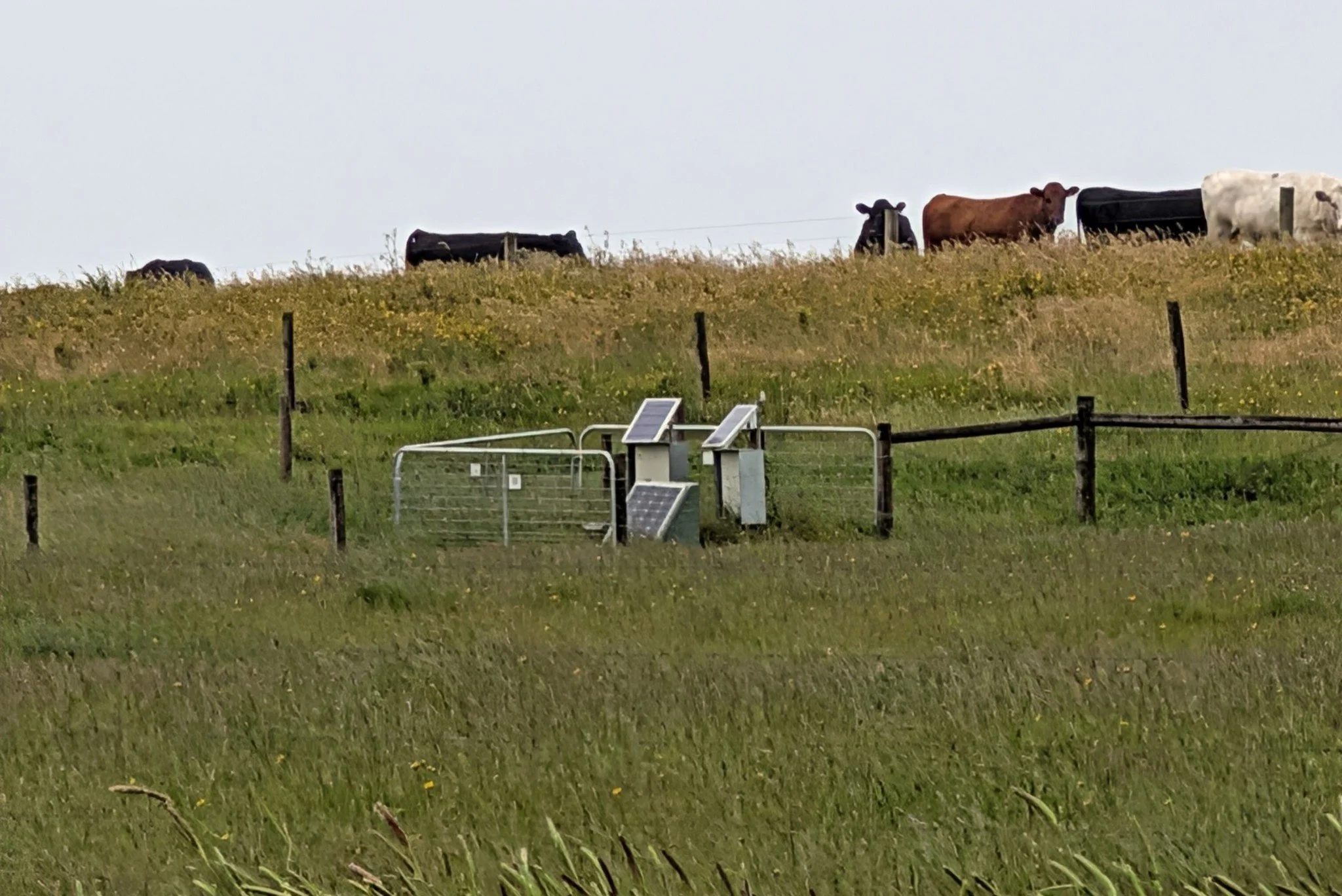
Geomechanical measurement: One of the tiltmeters at the Otway International Test Centre. Image: Dr Hadi Nourollah.
Seeing very small signals with very high resolution
At the OITC, as with most deep geological storage sites, processes associated with fluid movement and pressure redistribution can generate extremely low magnitude microseismic signals. These signals are a normal feature of subsurface systems and are far below perceptible levels.
What has changed is not subsurface behaviour, but the resolution of contemporary monitoring technologies. Modern instruments can now detect and characterise signals that were previously unobservable, allowing researchers to extract meaningful insights from very small subsurface responses.
This level of resolution is particularly valuable for understanding CO2 injection performance, including fluid migration and the response of the surrounding geological system during controlled injection. The same capability supports research into other subsurface systems where pressure, stress and fluid flow are important, including geothermal energy, hydrogen storage and natural gas storage.
Understanding the subsurface as a connected system
The strength of the AuScope – CO2CRC collaboration lies in the integration of complementary monitoring technologies. At the OITC, this includes:
Surface and near-surface measurements using gravimeters, tiltmeters and seismometers provided through AuScope
Continuous downhole measurements using fibre-optic Distributed Acoustic Sensing and Distributed Strain Sensing, deployed and investigated in collaboration with RITE, the University of Melbourne, CSIRO and Curtin University
This integrated framework enables researchers to examine:
Subtle changes along fault planes at depth
Millimetre-scale surface changes linked to pressure redistribution in the reservoir
The relationship between injection and storage performance to geomechanical response
These field-scale observations support the development of optimal injection and operational approaches, informed by high-resolution, effective geomechanical monitoring. The learnings are transferable to a wide range of subsurface applications where understanding deformation, stress evolution and system response is important.
A few weeks before the conference screening, Agent Tremor had already gained attention in Western Australia - the film was featured on WA Regional 7 News during Earth Science Week, where it was praised for its creativity and scientific clarity. Its success with both the public and the scientific community reflects the strength of the students’ storytelling and understanding of seismology.
Enabling CO2CRC’s Future R&D Program
This work underpins CO2CRC’s Future R&D Program in CO2 storage, which focuses on:
Advancing understanding of subsurface geomechanical processes
Developing scalable, field-validated geomechanical monitoring tools
Applying AI-enabled workflows to continuously analyse large, multi-sensor datasets and refine forward predictive models of subsurface systems
By combining contemporary monitoring data with advanced analytics, the Future Program supports timely performance assessment, improved interpretation of subsurface response, and confident operational decision-making. While a key focus is enabling commercial-scale CO2 storage, the program can also generate broader insights applicable across multiple subsurface industries.
The OITC provides a rare opportunity to develop and test these approaches in a controlled, field-scale environment, linking observations directly to modelling and interpretation.
The value of the Otway International Test Centre
The OITC is globally distinctive in its ability to host integrated monitoring experiments during controlled CO2 injection operations. No site worldwide combines:
Deep subsurface access
Permanent fibre-optic instrumentation
Dense surface and near-surface geophysical monitoring
An active, applied research program
Collaboration with AuScope, and through Australia’s NCRIS program, ensures nationally significant geophysical infrastructure is embedded within a living field laboratory. This approach supports a wide spectrum of geoscience research, from CO2 storage to emerging energy systems and fundamental studies of subsurface processes, strengthening our nation’s sovereign capability in decarbonisation.
“We are excited to be able to deploy NCRIS-enabled AuScope observational infrastructure at the Otway site. This collaboration with the CO2CRC will allow us to link regional and national-scale observations with the very detailed monitoring work being undertaken by the CO2CRC, creating valuable multi-scale datasets for the broader research community.”
- Dr Tim Rawling, CEO of AuScope
As CO2CRC works with AuScope on future NCRIS funding opportunities, this partnership highlights the importance of sustained investment in shared research infrastructure that enables high-impact, field-based science across multiple disciplines.
An invitation to collaborate
CO2CRC welcomes collaboration with researchers, technology developers and industry partners interested in advancing subsurface monitoring, interpretation and geomechanical understanding.
The combination of world-class instrumentation, field access and applied research capability at the OITC provides a unique environment to develop, test and validate new monitoring approaches, supporting more informed, more efficient and more confident use of the subsurface across a range of applications.
STORY IN A NUTSHELL
A collaboration between AuScope and CO2CRC is strengthening Australia’s capability to observe and interpret subtle subsurface processes associated with CO2 injection and storage, while also delivering insights relevant to a wide range of subsurface applications.
AUTHORS
CCS Insights Newsletter | This article has been published with the permission of CO2CRC
Editor: Daniel Vlahek, AuScope