
Professor Malcolm Sambridge Elected Fellow of the Royal Society
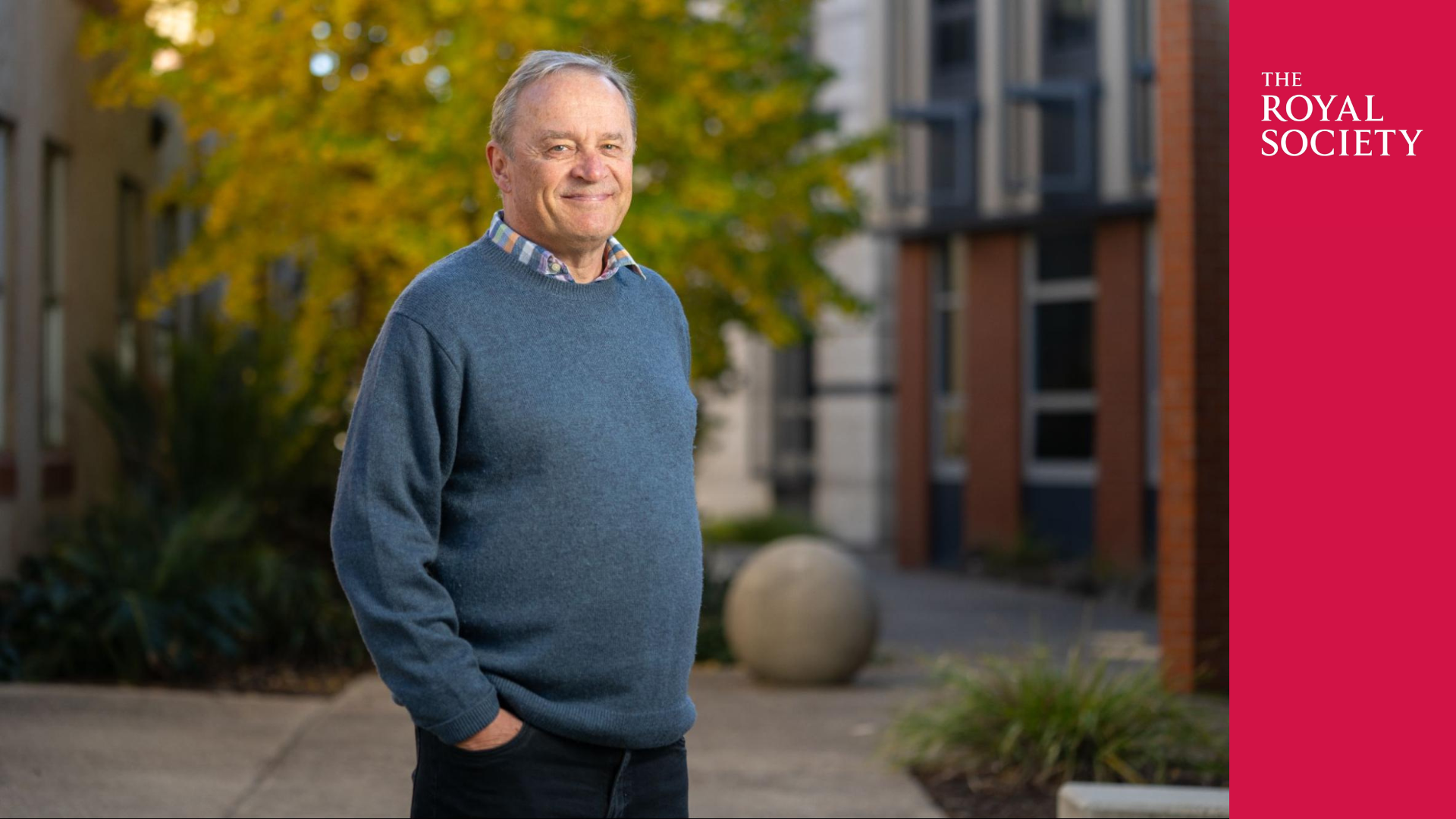
The honour is shared with all students, friends and colleagues who have educated and challenged me over decades. Image: Nic Vevers
Professor Malcolm Sambridge has been elected as a Fellow of the Royal Society, one of the world's oldest and most prestigious scientific academies. The honour recognises his fundamental contributions to understanding the Earth through the development of innovative mathematical approaches for analysing complex geophysical data. In this interview, Malcolm reflects on his scientific journey, the importance of curiosity, and the future of Earth science
Congratulations on being elected a Fellow of the Royal Society. What does this recognition mean to you?
I am both amazed and delighted to be elected. It’s an amazing honour that I did not expect, and one shared with all the students, friends and colleagues who have educated and challenged me over the decades. I have always thought of the Royal Society as representing the true spirit of science and research for the good of all. They support, explain and advocate for science internationally and count heroes of mine among their Fellowship. I simply can not believe they have elected me. At the same time, I won’t be asking for a recount.
Your research has helped transform how scientists interpret complex geophysical data. What first inspired your interest in understanding the Earth and its hidden processes?
I was originally a Physicist studying Applied Mathematics at the University of Cambridge (UK) when I was introduced to theoretical seismology, the mathematics of wave propagation in the solid earth. I was intrigued by how complex phenomena could be explained by equations. The theory written down on a sheet of paper could explain why observed phenomena occurred and make predictions about the real world.
The more I looked, the more I realised that the Earth Sciences had opportunities for people with a wide variety of science backgrounds.
It really is a meeting place for multiple scientific disciplines and requires cross-disciplinary communication to do truly new things. I was easily convinced that this was the subject for me.
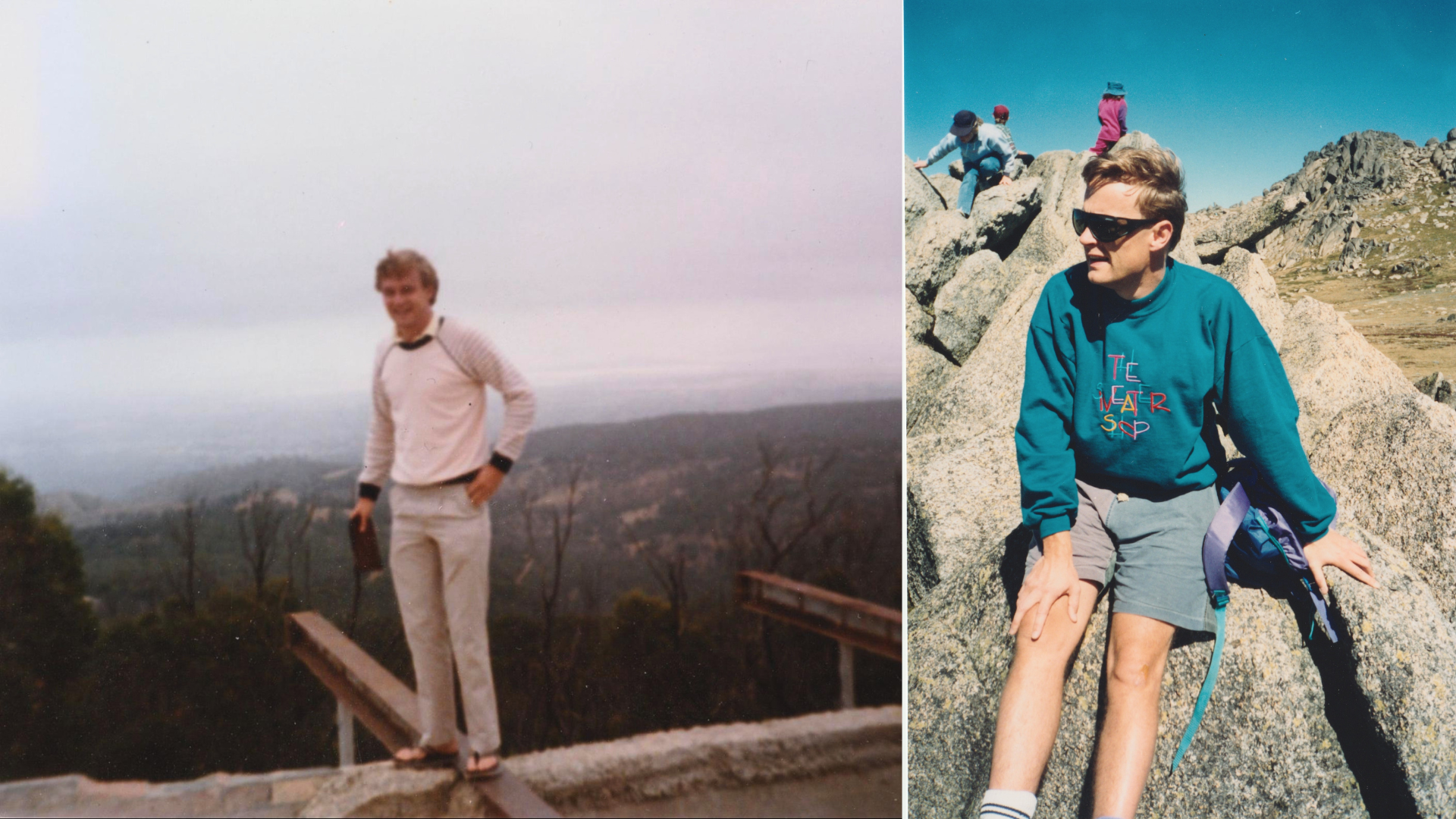
Left: A Ph.D. student at my very first conference in Adelaide in 1986. A lot younger. Note the thongs. Image: Brian Kennett. Right: Mt Kosciusko in 1994. Image: Julie Smith.
Your research has influenced areas ranging from seismology and Earth's interior to landscape evolution and mineral analysis. Is there a project or breakthrough that stands out as particularly memorable?
I expect the areas I am best known for are the development of new styles of inversion algorithms for solving geophysical and other problems. The Neighbourhood Algorithm was a hit and saw a lot of take-up, but that was many years ago now. It has been used for a long time, which I guess shows it met a need.
I was very happy with our contribution to what has become known as ‘Trans-dimensional’ inverse problems. Where “one of the things that you don’t know is the number of things that you don’t know”. I am particularly excited by the thought of applying a mathematical technique to a new area or data class, to see what we can learn. I’ve tried to do this over and over, bringing ideas from one area and applying them to another area. For me, this creates a way of doing things that couldn’t be done before. When it works, it’s very satisfying and a lot of fun.
Geoscience plays an important role in helping society respond to challenges such as natural hazards, resource security and environmental change. Why do you think Earth science is more important than ever?
Many of the challenges facing society today involve the Earth Sciences in one way or another, from climate change to natural hazards to resourcing and managing the energy transition.
There is a major demand for skilled people, new data and new ideas that could make an important difference to societies in meeting these challenges. Beyond society relevant challenges, there are also major new opportunities for discovery, on and within our planet and also our neighbouring moon and Mars, where new data is coming online.
At the same time, the level of education in related disciplines, and perhaps the public image of Earth Sciences more broadly, is not at a level that can meet these challenges. Earth Science schools are closing, and public perceptions are distorted. People simply are not aware of the importance and the riches to be found in our field. It is incumbent on all of us to change this with communication and advocacy.
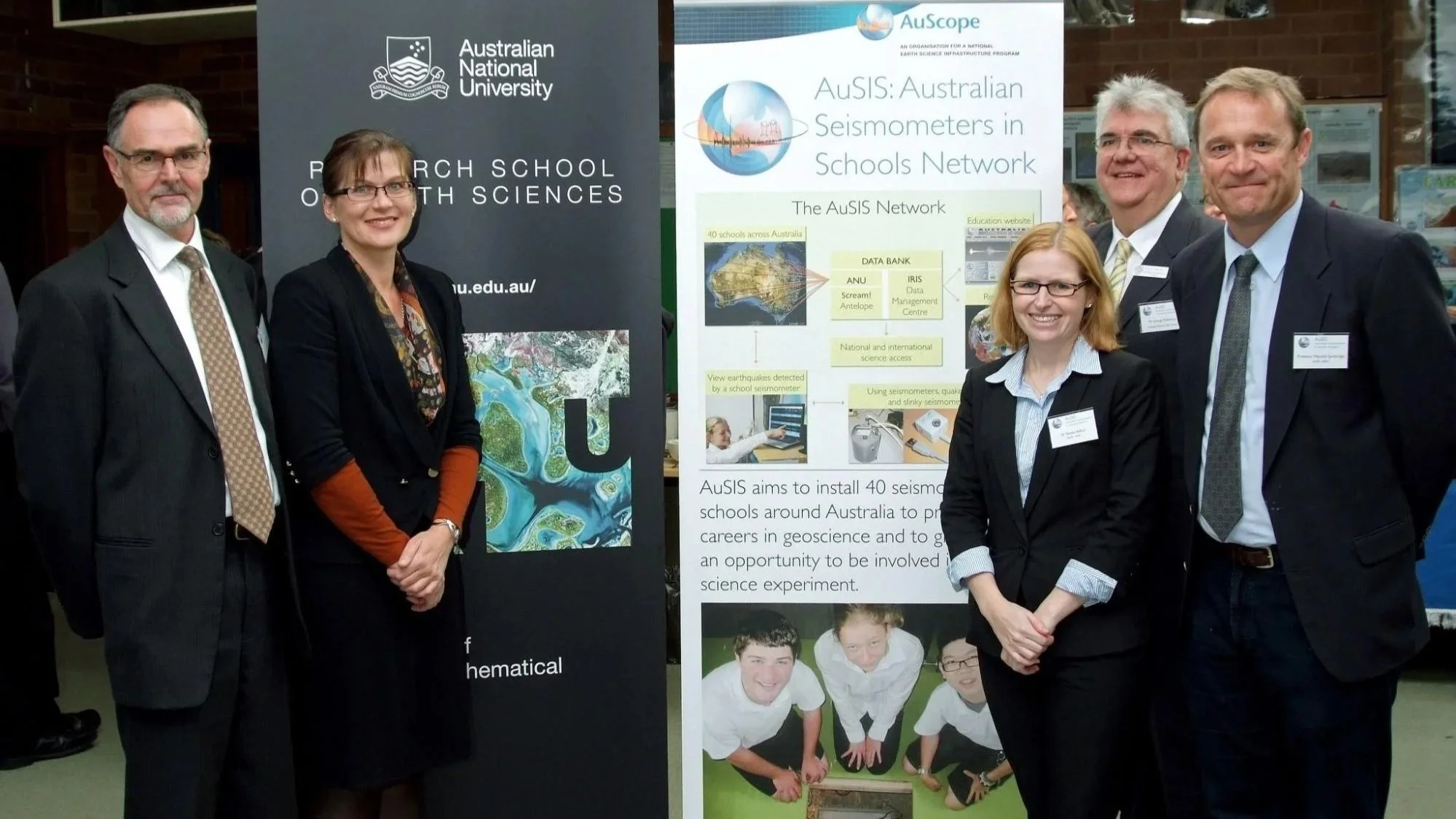
At the launch of the Australian Seismometers in Schools network in 2013. From left: Bob Haydon, former CEO of Auscope; Kate Lundy, Federal MP at the time; Natalie Balfour AUSIS co-ordinator; Principal of Melrose High School in the ACT, where the launch took place; and Professor Malcolm Sambridge.
Over the past decade or more, I have been involved with the AuScope Australian Seismometers in Schools program, a dual outreach and science data project. We have built a network of 50 high-fidelity seismometers in high schools across Australia and provide real-time data for earthquake monitoring and research. It has been very rewarding to see geoscience as a hands-on activity in high schools, raising awareness of STEM as a career pathway for students, and also to see the data used by national agencies and researchers worldwide.
What advice would you give to students and early career researchers considering a future in geoscience?
Explore its diversity of fields and challenges, and you will find a home. Just because you have not studied or thought about the Earth Sciences before, does not mean it’s not for you. If you are interested in physics, chemistry, biology, geology, engineering, mathematics, environmental or computer science, there is a place for you. I have seen amazing contributions from people from all of these backgrounds.
A conversation between
Professor Malcolm Sambridge and Philomena Manifold (AuScope)
FURTHER INFORMATION
The Royal Society
Founded in 1660, the Royal Society is the world's oldest scientific academy in continuous existence and one of the highest honours in science. Its Fellowship recognises researchers who have made exceptional contributions to scientific understanding and innovation
Find out more about Professor Malcolm Sambridge and the 2026 Royal Society Fellows.