Beta-Decay Geochronology Expert Working Group
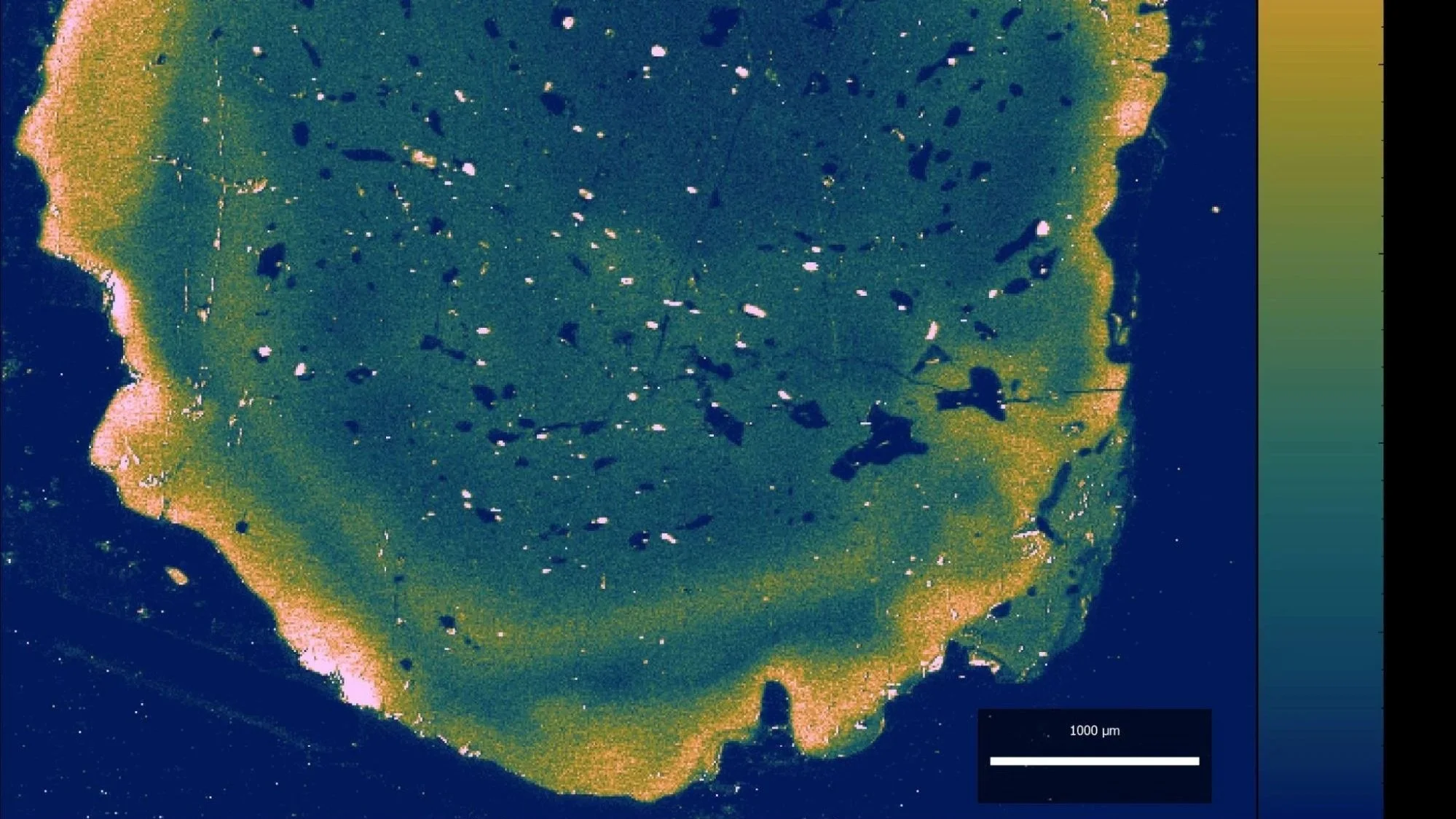
Garnet from the Sleaford Complex in South Australia mapped with LA-ICP-TOF-MS. Grain exhibits zoning and inclusions which can be spatially targeted or avoided by new in-situ Lu-Hf beta-decay geochronology techniques. Image: Alex De Vries Van Leeuwen
About Us
Beta-minus and beta-plus geochronology utilises radioactive decay systems in which both parent and daughter isotopes have the same mass, in order to date a broad suite of minerals such as garnet, apatite, micas, feldspar and calcite at sub-100 𝜇m resolution. Traditionally, instruments have been unable to measure these systems without first requiring time-consuming wet chemistry and loss of textural information, but recent advances in technology have allowed rapid, laser-based dating with these systems, including in-situ analysis. This group brings together international experts on beta-decay dating systems to improve data standards, tools and reference materials for the community.
Overview
The beta-decay expert working group brings together world leaders in in-situ beta-decay geochronology from around the globe, including specialists in systems such as Rb-Sr, Lu-Hf and Re-Os. These geochronology tools allow fast, spatially resolved dating of minerals across a wide range of igneous, metamorphic, sedimentary and mineralised systems.
These in-situ techniques have only become available within the last decade, and as a result remain an evolving field of research and are experiencing a phase of rapid uptake by laboratories across the world. It is important that alongside the research and applications facilitated by these methods, that the community establishes agreement and transparency on the best practice for analysing, processing, and reporting data.
This working group establishes an international community of experts on in-situ beta-decay acquisition techniques and geochronology systems, to help provide resources to make data findable, accessible, interoperable and reproducible (FAIR) and consistent with the principles of Open Science. Many of the resources produced by this group are being implemented into the AuScope enabled EarthBank platform, which provides researchers and laboratories the digital infrastructure to efficiently store and publish data and analytical information within laboratory and research workflows.
“The new instruments and laser methods for beta-decay dating allow fast, in-situ analysis of samples with quite little preparation. These methods are a step change for geochronology, opening up a whole suite of new datable minerals we never had access to before”
- Dr. Angus Nixon
Resources
Lu-Hf templates coming soon!!
Projects
ICP-MS/MS Analytical Metadata Reporting Guidelines
Beta-decay geochronology has been revolutionised by the emergence of new mass spectrometry technology, the first being ICP-MS/MS instruments which utilise two quadrupole mass filters separated by a reaction cell. The reaction cell allows the highly reactive ionised sample material to be reacted with a selected gas in order to create reaction products which ‘shift’ the mass of the ions and allow isotopes of the same mass and charge to be separated by the second quadrupole filter and measured. This allows isotopes of the same mass, such as Lutetium-176 and its daughter isotope Hafnium-176, to be measured by laser ablation or solution sampling without the need for traditional wet chemistry separation. This project is working with global experts to design a reporting template and minimum requirements for ICP-MS/MS analytical parameters, designed to flexibly store instrument settings used during acquisition of a number of beta-decay dating systems.
Lu-Hf Geochronology Reporting Guidelines
One of the most common geochronology systems enabled by ICP-MS/MS is Lu-Hf dating, which utilises the decay of Lutetium-176 to Hafnium-176 by beta-minus decay. Lutetium is a heavy rare Earth element, and may be concentrated in minerals such as garnet, apatite, monazite, calcite, and fluorite, allowing for the in-situ dating of such Lu-bearing mineral phases. The working group has developed comprehensive reporting guidelines for researchers to publish their data and analytical conditions, which are vital for others to interpret and reuse these results in the future.
Lu-Hf Reference Material Interlaboratory Testing
Currently in-situ Lu-Hf geochronology has a limited number of high quality reference materials for both calibration and QAQC checks, which need to be matched to the minerals analysed. By connecting laboratories conducting these analyses in Australia and internationally, the working group is identifying current reference materials and promising candidates which can be shared and tested across multiple laboratories, with the goal of characterising and promoting more reference materials for the community.
Rb-Sr Geochronology Reporting Guidelines
Another common geochronology system enabled by ICP-MS/MS is Rb-Sr, which uses the decay of Rubidium-86 to Strontium-86 by beta-minus decay. Rubidium is a large ion lithophile element that can commonly substitute in for Potassium, and can be found in significant concentrations in phases such as clays, feldspars and micas. These minerals are common across many igneous, metamorphic and sedimentary systems and can be used to date both mineral growth and later thermal or fluid events the rock has experienced. The Rb-Sr system and analytical procedure is in many ways highly similar to the Lu-Hf system, which will allow the reporting principles and guidelines developed for Lu-Hf to be repurposed for Rb-Sr to provide consistent formats for the in-situ beta-decay geochronology community.
“As in-situ beta-decay geochronology is a relatively new method, the community has an almost unique opportunity to coalesce around a shared standard for data reporting”
- Dr. Angus Nixon
Expert Working Group Name
Beta-Decay Geochronology Expert Working Group
Working Group Lead

Focus Areas/Applications
Beta-decay geochronology, electron-gain geochronology, data standards
Members
Professor Stijn Glorie | Adelaide University
Dr Sarah Gilbert | Adelaide University
Professor Olivier Alard | Australian National University
Dr Bryant Ware | Curtin University
Dr Hui-Qing Huang | James Cook University
Dr Kai Rankenburg | Curtin University
Dr Jeffrey Oalmann | University of Tasmania
Professor Pieter Vermeesch | University College London
Dr Brandon Mahan | University of Melbourne
Dr Jarred Lloyd | Adelaide University
Professor Wolfgang Müller | Goethe University Frankfurt
Professor Thomas Zack | University of Gothenburg
Dr Alex Simpson | British Geological Survey
Dr Delia Rosel | University of Gothenburg
Dr David Murphy | Queensland University of Technology
Dr Hugo Olierook | Curtin University
Dr Martin Kutzschbach | Goethe University Frankfurt
Dr Melissa Kharkongor | University of Queensland
Dr Allan Gomes | University of Tasmania
Dr Bhavik Lodhia | Curtin University
Collaborators
AuScope Program