
Visualise, analyse & extract geochemistry data from around the globe

EarthBank is a platform for easily visualising, analysing and extracting georeferenced data produced by geochemistry laboratories around the world.
It is the first step in the AuScope Geochemistry Network (AGN) team’s mission to create a coherent network of geochemical laboratories that contribute data to central and FAIR repositories, enabling researchers to solve the global geoscience challenges of today and tomorrow.
FAIR data, analytics & community in one place

View your area of interest, synthesise a variety of geochemical data and extract what you need. EarthBank supports these data types and more:
— LA-ICP-MS and SIMS U-Pb geochronology
— Major, minor and trace element geochemistry
— K-Ar and Ar-Ar geochronology
— Fission track thermochronology
— (U-Th-Sm)/He thermochronology
— Thermal history simulations
— Hf-isotope geochemistry

Gain novel scientific insights through multi-method data collation. Lithodat has powered the EarthBank platform with unique built-in data synthesis functions, such as cumulative age histograms, age vs. elevation plots, and step-heating diagrams, allowing for rapid inter-study comparisons.
Data can be extracted in multiple formats to be used in a variety of software systems, allowing for the integration of regional data sets into machine learning and AI systems.

EarthBank provides a platform for geochemistry laboratories to enter, organise and analyse their data in collaboration with researchers and industry. EarthBank allows you to enter your own data in an existing global database whilst reserving permission options.
Become a data contributor
Incorporate your data into AusGeochem and help build a FAIR data ecosystem.
News

Announcing the winners of AuScope’s 2024 Opportunity Fund. This initiative funds research projects to boost earth science infrastructure capacity and access.

In June 2024, NCRIS-enabled researchers joined a JAMSTEC mission off Japan's coast to explore deep-sea volcanoes to enhance our understanding of Earth's mantle dynamics, biogeochemical cycles, and tsunami mechanics.

The AuScope Geochemistry Network (AGN) brought together NCRIS enabled AGN scientists from Australia’s top universities with national and global Earth science organisations to showcase diverse projects and explore future digital infrastructure.

The 2023 Australian Earth Sciences Convention (AESC) held on Noongar Whadjuk boodja (country), will feature new geoscience insights from the Australian lithosphere to Earth's evolution and resources. Join us for NCRIS talks, workshops, presentations, and a shared booth with ANZIC.

The NCRIS enabled partnership between Australia’s national science agency CSIRO and the AuScope Geochemistry Network (AGN) has successfully preserved a valuable collection of geochemical data.

David Upton from Precompetitive Review explores AusGeochem's ability to visualise diverse data. He takes a closer look at the North Australia Craton and North China Craton in the Proterozoic with Dr Samuel Boone.

Recently, teams from our AuScope Geochemistry Network team and Museums Victoria collaborated to enhance researcher access to an extensive collection of data for museum-held rocks and mineral specimens via the NCRIS enabled AusGeochem platform. Here collaborators share details of their successful project.

Through AuScope’s AGN+ pilot project, the AuScope Geochemistry Network has expanded to 13 facility-based nodes from partner institutions across Australia. Recently, this expanded team consortium of Earth Science institutes met in Melbourne for the first time.
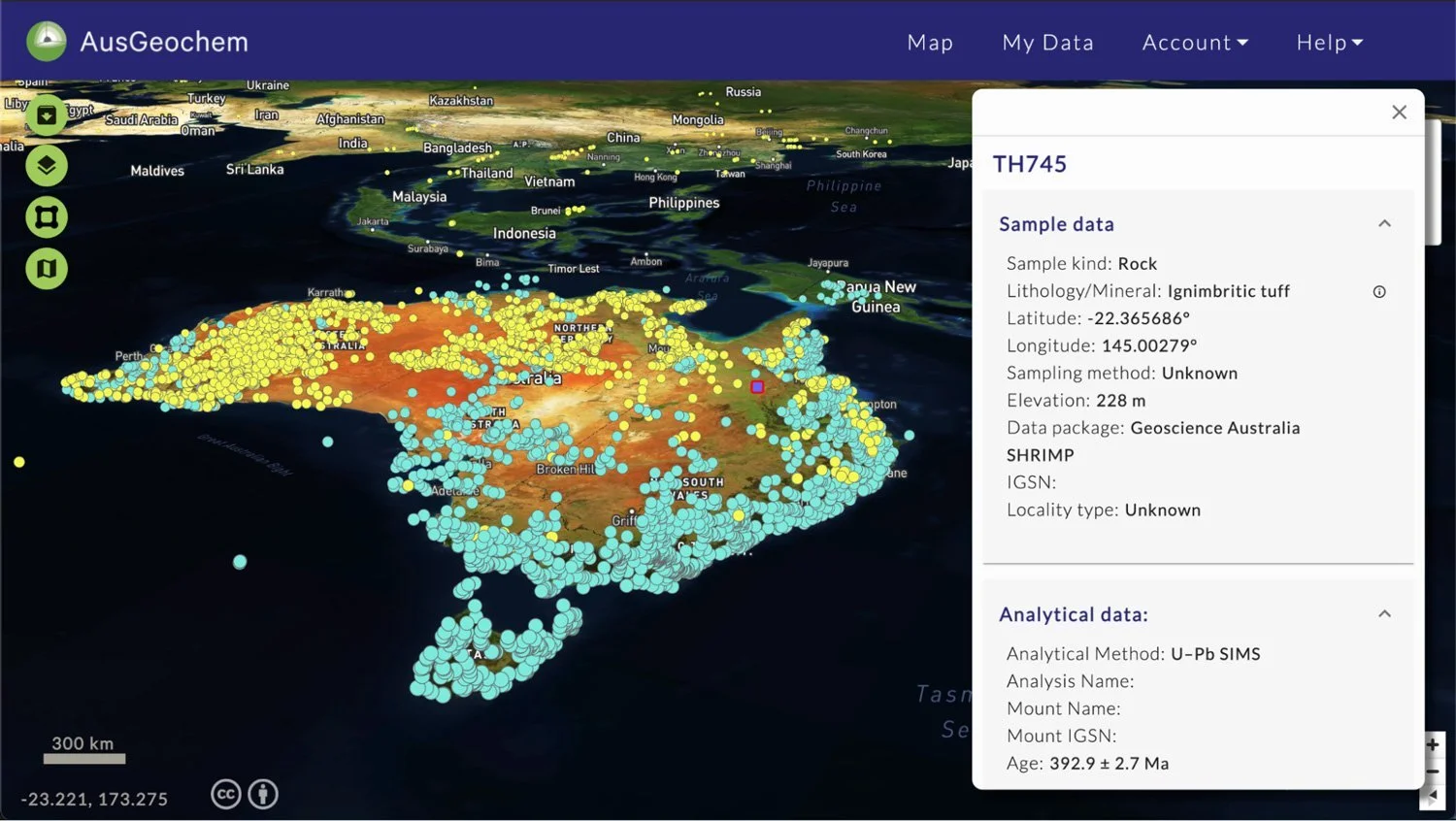
More than fifteen months of work for the AuScope Geochemistry Network (AGN) and partners Lithodat have recently culminated in the release of the AusGeochem platform. Let’s meet the faces behind the platform!

The AGN Project Team and collaborators Lithodat are excited to announce that the first iteration of the AusGeochem platform is now live! AusGeochem is a cloud-hosted open geochemistry data platform that is simultaneously a geosample registry, a geochemistry data repository, and an active research tool.


In the AGN’s 6th public webinar, Dr Matthew Gard, Dr Derrick Hasterok (both University of Adelaide) and Dr Jacqueline Halpin (University of Tasmania) delivered a webinar on building an internally consistent whole rock geochemical database, and analysis tools that are easily accessible and usable.

In the AGN’s fifth public webinar we heard from Dr Marnie Forster of ANU, the project leader for The National Argon Map project (NAM), who discussed the motivations behind the initiative and how geoscientists can get involved.

The AGN project team, together with the development team at Lithodat, continue to make fantastic progress on the construction of AusGeochem, with user experience front of mind. The platform is now in the internal alpha testing phase, where sample information can be uploaded and displayed graphically on the interactive map display.

Since our last update members of the AuScope Geochemistry Network (AGN) have presented at a number of conferences, developed proposals for the expansion of the network and made great progress on the development of the AusGeochem platform and a new project, LabFinder.

The year 2021 started quickly for the Australian Earth Science community, with the Australian Earth Science Convention (AESC) taking place in February. This year, proceedings took place completely online and with an innovative format including both pre-recorded and live-streamed presentations, allowing participants to take conversations deeper during Q and A sessions.

It’s rare to have a mineral named after oneself, but it’s something that distinguished Professor Sue O’Reilly can now add to her extensive accolades after a rare and exotic mineral from the Mt Carmel Ranges in Israel was recognised in an NCRIS and AuScope enabled Macquarie GeoAnalytical (MQGA) facility in Sydney.

In the AGN’s fourth webinar in the series we heard from the Macquarie University GeoAnalytical (MQGA) team as they discussed their evolution in analytical capabilities over the past 25 years and the development of the TerraneChron methodology.

In the AGN’s third webinar, we heard from the Melbourne Low-Temperature Thermochronology Research Group and Lithodat about the history of their extensive sample archive and successful integration into AusGeochem.

In our second webinar, we heard learned about the vast McNaughton SHRIMP collection in Western Australia, and previewed the fast-growing AusGeochem Platform.

The Government of Western Australia announced a $3.2M co-investment with AuScope and Curtin University today to enable the replacement of a 27-year old instrument at the John de Laeter Centre (JdLC), allowing researchers to continue to unveil secrets of the universe.

In our first webinar, the AGN team discussed our progress in building the AusGeochem platform and introduced our aims to create a collaborative network for all Australian geochemistry laboratories.

Despite a challenging start to the year, we have been working busily behind the scenes around the country to co-design with the geochemistry community a digital solution that makes geochemical data FAIR. And excitingly, our team has grown.

Introducing the AuScope Geochemistry Network (AGN), a new project within the AuScope Earth Composition and Evolution (ECE) Program which aims to create, coordinate, promote and develop national geochemistry research infrastructure and maximise its use by the Australian research community.
Sample EarthBank Views
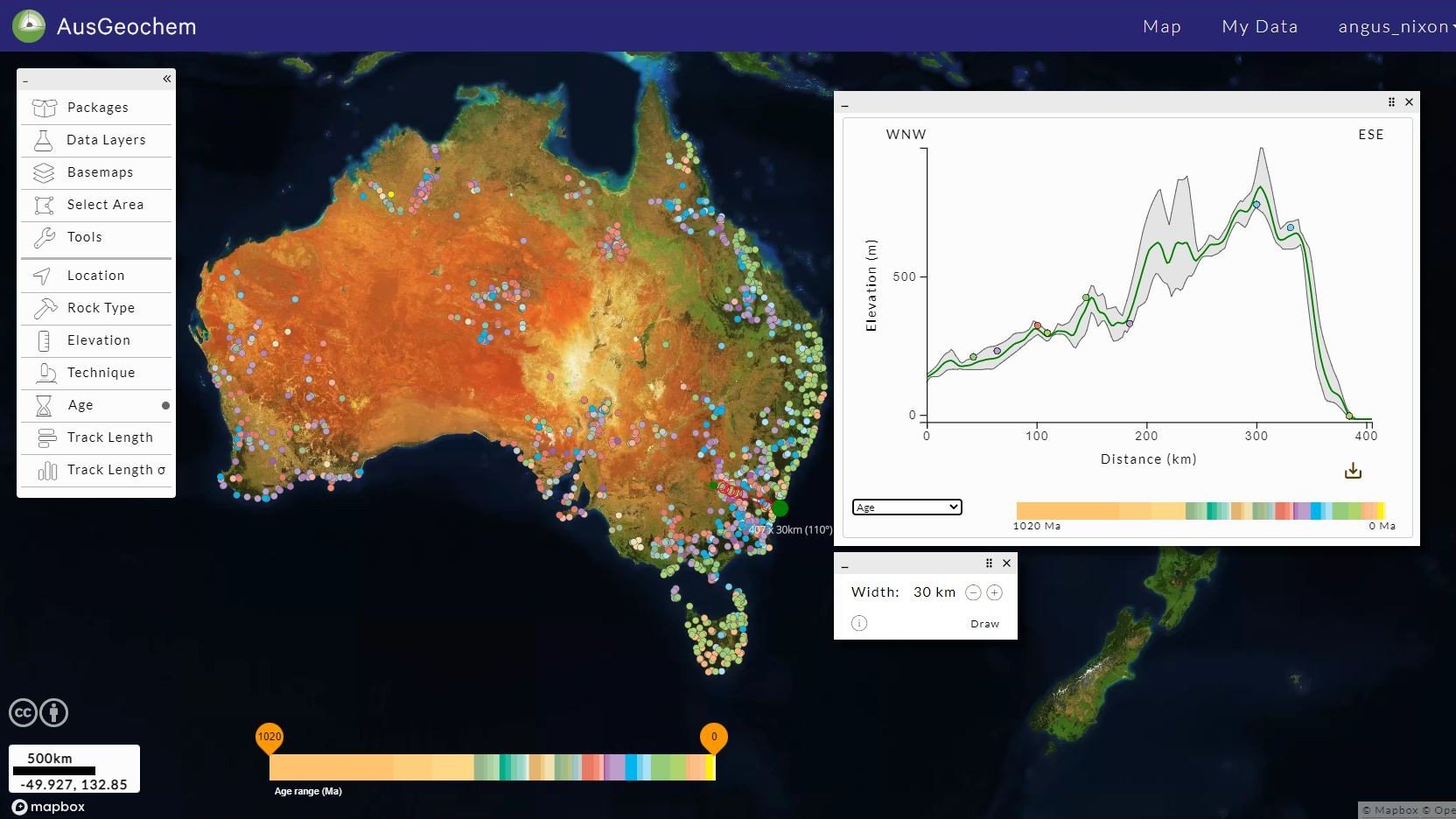
ThermochronOz2002: Australian apatite fission track (AFT) collection provided by the University of Melbourne (Kohn et al., 2020; Kohn et al., 2002; Gleadow et al., 2002).
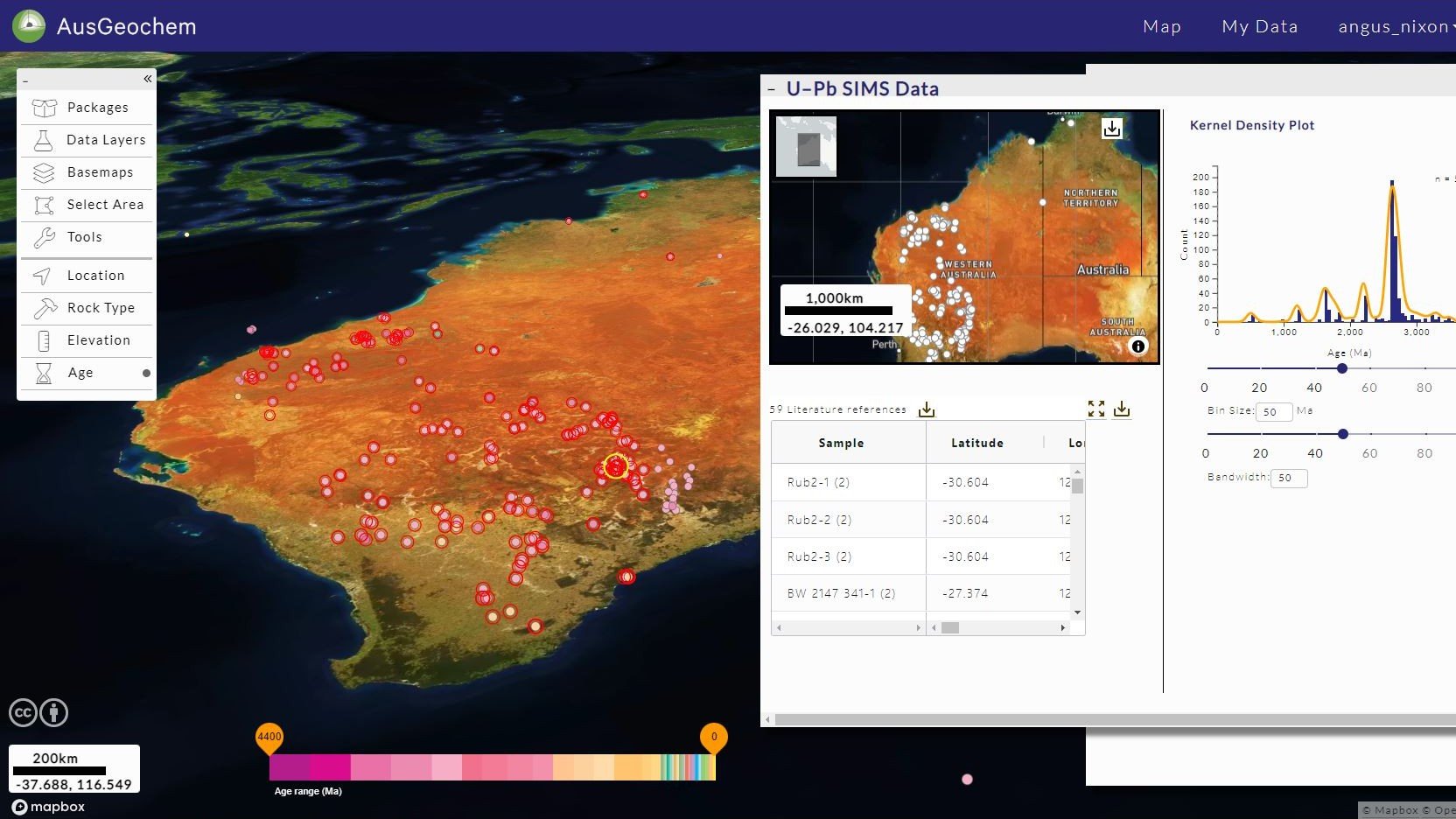
McNaughton Legacy Collection: Legacy collection of Sensitive High-Resolution Ion MicroProbe (SHRIMP) mounts donated to the Geological Survey of Western Australia (GSWA) by Professor Neal McNaughton of the John de Laeter Centre, Curtin University. Data and mounts are provided as part of the Curtin University Preservation of Legacy Collections Project (Blereau and Bellenger, 2022).
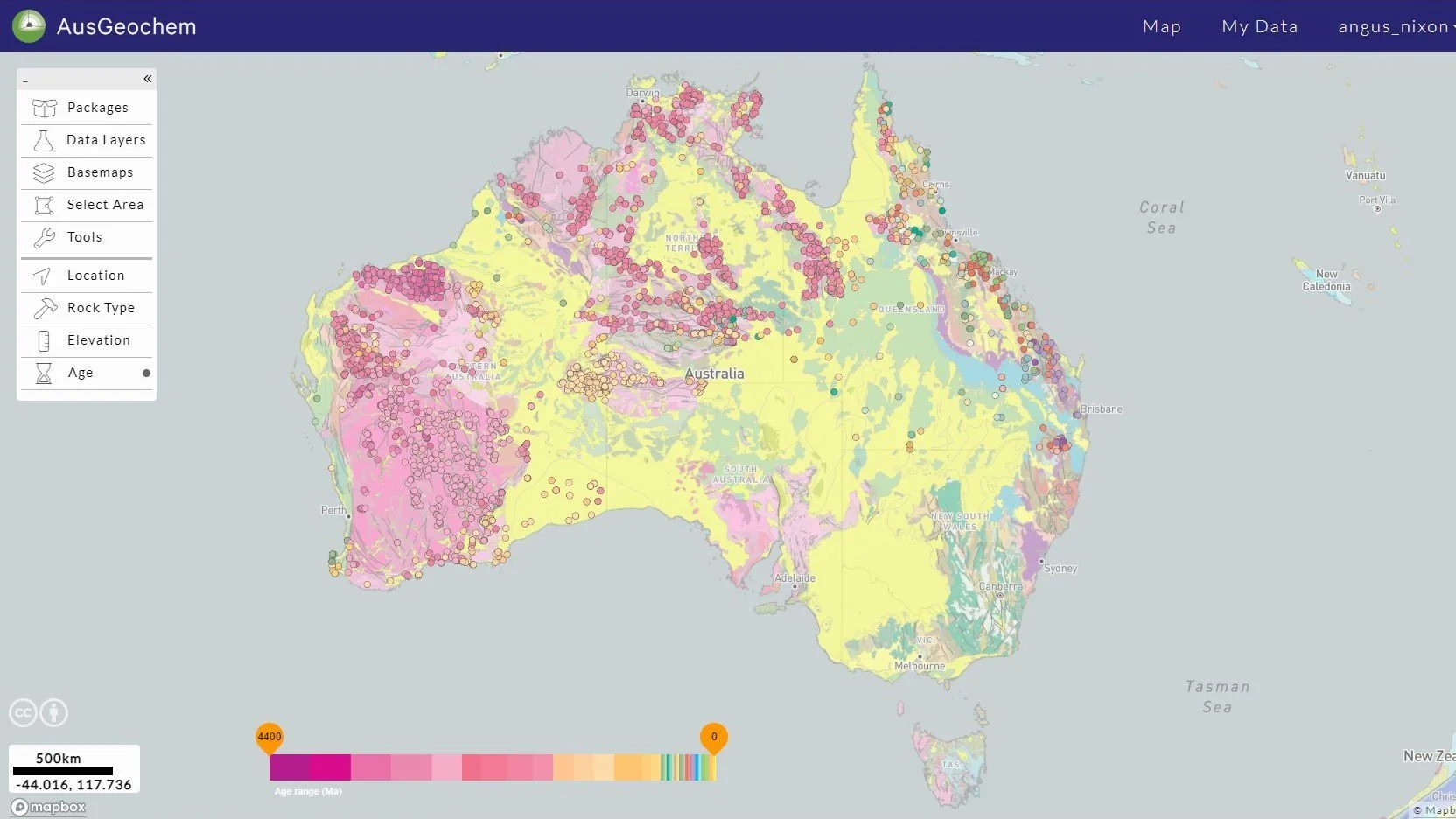
Geoscience Australia compiled U-Pb, northern Australia, 2018: Publicly available Sensitive High-Resolution Ion MicroProbe (SHRIMP) U-Pb geochronology from QLD, NT, WA, and the most northerly parts of SA and NSW, compiled by Geoscience Australia (GA), from both GA and literature sources, published in Jones et al. (2018). Complete analytical data for a subset of the GA results are available from Geochron Delivery [Version 2, 2018].

Museums Victoria Petrology & Museums Victoria Mineralogy: Records for rock, mineral and ore specimens in Victoria’s State collections. These globally significant collections include over 66,000 registered specimens, representing over 2,800 mineral species and 130 type mineral specimens. Specimens in Victoria’s State collections are available for research use: you can find details here or email Museums Victoria directly for more information.

Steve Barnes (CSIRO) Ni-PGE Geochemistry Collection: CSIRO collection of geochemical data from over 5,700 mafic-ultramafic rocks and associated nickel-copper-cobalt and platinum group element ores from Western Australia. This flagship resource was collated by Dr Steve Barnes while working with CSIRO from the mid-1980s to 2021 and has been preserved in collaboration with AuScope and is now available in the AusGeochem platform.
STAY INFORMED
ABOUT US
EarthBank is being developed by the AuScope Geochemistry Network (AGN) and partners, Lithodat, with contributions from an expanding collaboration network. You can find out more about us, our work, our partners, and how to get involved here.
THE AUSCOPE EARTHBANK TEAM
Prof Brent McInnes, Curtin University
Prof Andy Gleadow, The University of Melbourne
Dr Bhavik Lodhia, Curtin University
Dr Bryant Ware, Curtin University
Dr Samuel Boone, The University of Melbourne
Dr Brandon Mahan, The University of Melbourne
Dr Yoann Greau, Australian National University
Prof Olivier Alard, Australian National University
Prof Barry Kohn, The University of Melbourne
Prof David Philipps, The University of Melbourne
Dr Hayden Dalton, The University of Melbourne
Dr Malcolm McMillan, The University of Melbourne
Dr Angus Nixon, The University of Adelaide
Dr Florian Dux, University of Wollongong
Dr Halimulati Ananuer, Australian National University
Dr Jack Stirling, The University of Western Australia
Dr Jeffrey Oalmann, The University of Tasmania
Prof Sebastien Meffre, The University of Tasmania
Dr Allan Gomes, The University of Tasmania
Prof Ioan Sanislav, James Cook University
Dr Leonidas Vonopartis, James Cook University
Prof Tony Kemp, University of Western Australia
Dr Chris Fisher, University of Western Australia
Prof Charlotte Allen, Queensland University of Technology
Prof Stijn Glorie, Adelaide University
Dr Renjie Zhou, University of Queensland
Prof Anthony Dosseto, University of Wollongong
Dr Ziyi Zhu, Curtin University
Dr Kai Li, University of Sydney
Ms Belinda Northeast, Curtin University
Dr Fabian Kohlmann, Lithodat Pty Ltd
Dr Wayne Noble, Lithodat Pty Ltd
Mr. Moritz Thiele, Lithodat Pty Ltd
AUSCOPE EARTHBANK STEERING COMMITTEE
Dr Tim Rawling (AuScope CEO)
Dr Lesley Wyborn (Australian National University)
Dr Geoff Fraser (Geoscience Australia)